UK-based HexSeed raises over €700k to cool AI data centres with diamond coating technology
HexSeed Technology, a carbon capture and utilisation (CCU) startup that transforms captured CO₂ into high-value supermaterials, has raised over €700k (£600k) in early-stage funding.
The funding was led by Carbon13, with participation from Net Zero Technology Centre and Vento Ventures. The cumulative investment also unlocks a Partnership Grant from Innovate UK, awarded on a provisional basis earlier this year.
“Data centres are on track to consume a significant share of UK grid capacity within the decade, and a large proportion of that energy is lost as heat in power conversion. This funding will allow us to take our low-temperature diamond coating technology which we are developing from laboratory demonstration to working GaN devices,” said Mark Tandy, CEO and co-founder of HexSeed.
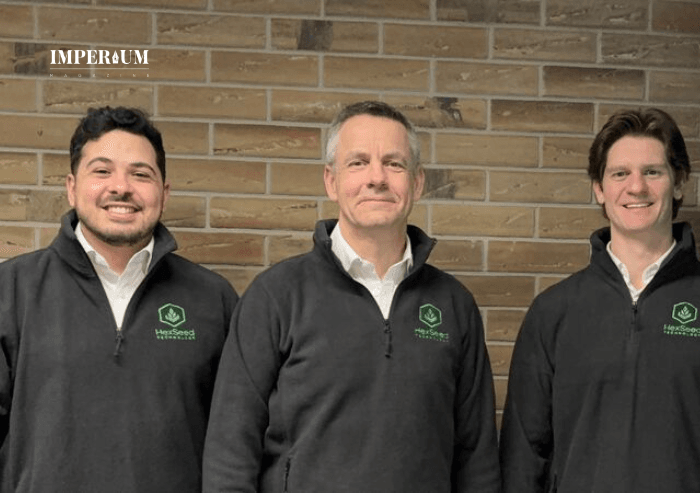
HexSeed Technology was founded in late 2025 by Mark Tandy (CEO, Oxford MBA), Dr Leonardo Santoni (CTO, PhD in Chemistry from UCL), and Dr Michael Glerum (COO, PhD in Engineering from Cambridge). The company also works closely with the University of Bristol.
HexSeed is developing technology designed to reduce energy waste in data centres that power artificial intelligence. The company says data centres already use a significant amount of global electricity, with the International Energy Agency (IEA) expecting demand to reach 945 TWh by 2030 as AI-focused data centres continue to grow. Much of this electricity is ultimately released as heat.
The company says gallium nitride (GaN) transistors are much more efficient at converting electricity than traditional silicon devices, but they generate significant heat. This heat is one of the main challenges preventing GaN technology from reaching its full potential.
Diamond is known as one of the best materials for conducting heat. However, conventional diamond production requires extremely high temperatures that could damage or destroy finished semiconductor devices.
Working with University of Bristol professors Paul May, an expert in diamond materials, and Martin Kuball, a specialist in semiconductor devices and thermal management, HexSeed is developing a low-carbon, low-temperature process to apply diamond coatings directly to completed GaN devices without damaging them.
“Together with researchers from the University of Bristol, HexSeed is developing a low-temperature microwave plasma process that grows diamond coatings directly onto finished GaN devices, pulling heat away from the active regions so they run harder, last longer, and use less energy,” the startup explained.
The company plans to use the funding to demonstrate its coating technology on commercial GaN power devices and move toward pilot projects with customers. Its initial focus will be on power conversion hardware used in data centres.