Small Business or Corporation: Which Business Structure Is Right for You?
Starting a business is an exciting journey, but one of the first and most important decisions you need to make is choosing the right business structure. The structure you choose affects how your business operates, pays taxes, handles legal responsibilities and grows in the future. It also determines your personal liability, ownership rights and ability to raise money.
Two of the most common business structures are a small business and a corporation. Both aim to earn profits and serve customers, but they work in different ways.
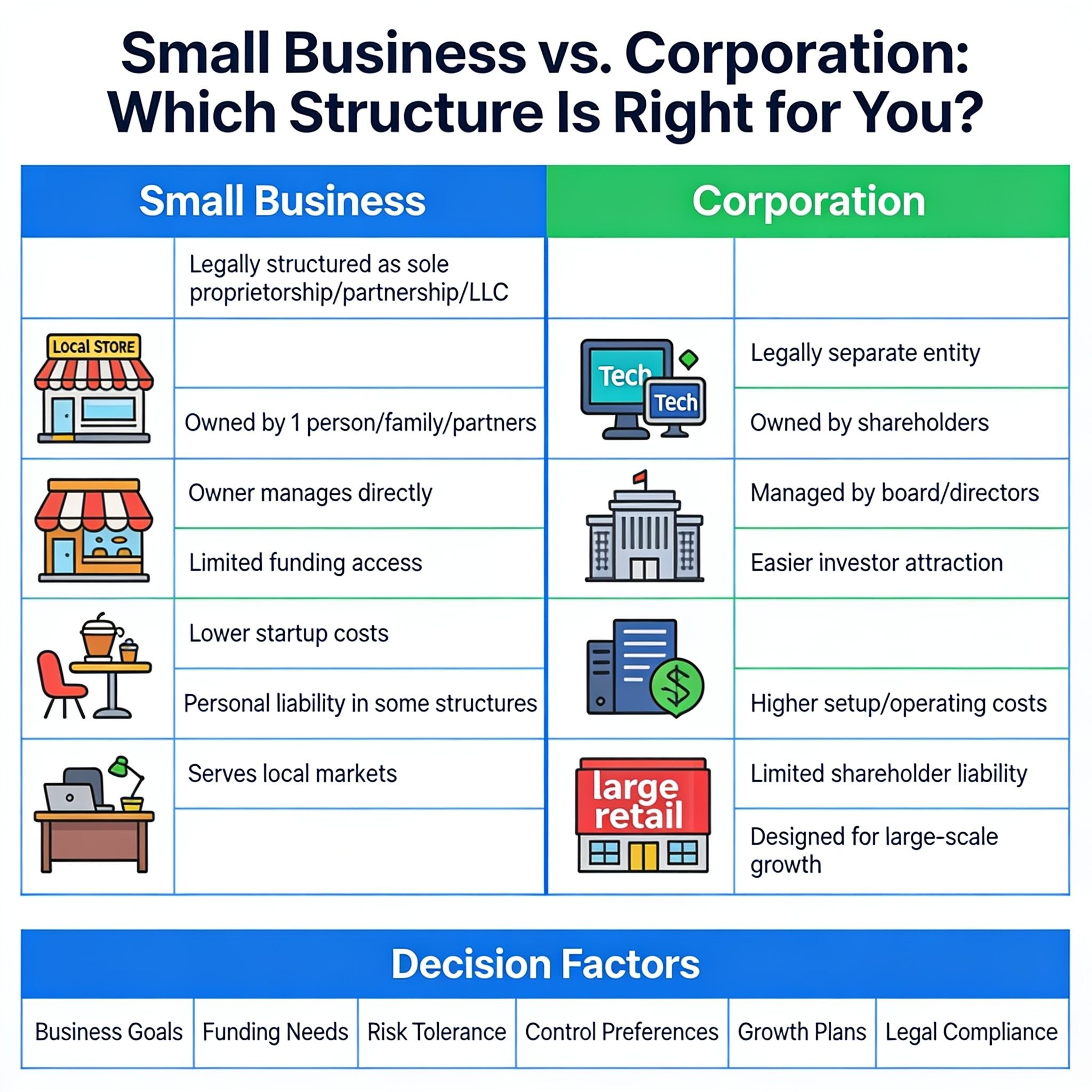
A small business is usually owned and managed by one person or a few partners. It is easier to start, has fewer legal requirements and allows the owner to make decisions quickly. A corporation, on the other hand, is a separate legal entity from its owners. It offers better liability protection, makes it easier to attract investors and is designed for businesses that plan to grow on a larger scale.
What Is a Small Business?
A small business is an independently owned business with a small number of employees and lower revenue than large companies. It is usually owned by an individual, a family or a small group of partners. Small businesses are important because they create jobs, support local communities and provide useful products and services.
A small business can operate as a sole proprietorship, partnership or limited liability company (LLC). Most are managed directly by the owner and mainly serve local customers or a specific market.
Examples of Small Businesses
- Local retail stores
- Restaurants and cafés
- Consulting firms
- Freelance service providers
- Home-based businesses
- Small manufacturing units
What Is a Corporation?
A corporation is a business that is legally separate from its owners, called shareholders. Because it is a separate legal entity, it can own property, sign contracts, borrow money and file lawsuits in its own name.
One of the biggest advantages of a corporation is limited liability. This means the personal assets of shareholders are generally protected from business debts. Corporations are a good choice for businesses that want to grow, raise money from investors and expand into larger markets.
Ownership is divided into shares of stock, and the business is managed by a board of directors and company executives.
Examples of Corporations
- Technology companies
- Manufacturing companies
- Financial institutions
- Publicly traded companies
- Large retail chains
Challenges of a Small Business and Corporation
Small Business
- Limited access to funding
- Harder to compete with large companies
- Owner handles most decisions
- Smaller workforce and fewer resources
- Difficult to expand quickly
- Cash flow problems during slow business periods
Corporation
- Expensive and time-consuming to set up
- Must follow many legal and government rules
- Higher operating and administrative costs
- More complex tax filing
- Slower decision-making
- Possible disagreements between shareholders and management
Differences Between Small Businesses and Corporations
Basis of Comparison | Small Business | Corporation |
Legal Structure | Operates as a sole proprietorship, partnership or LLC. | Separate legal entity from its owners. |
Ownership | Owned by one person or a few partners. | Owned by shareholders. |
Liability | Owners may be personally responsible for business debts. | Shareholders have limited liability. |
Management | Managed by the owner or a small team. | Managed by directors and company officers. |
Decision-Making | Quick decisions by the owner. | Decisions often require approval from directors or shareholders. |
Taxation | Business income is usually taxed as the owner's personal income. | Pays corporate taxes and follows corporate tax rules. |
Capital Raising | Uses personal savings, loans or a few investors. | Can raise money by selling shares. |
Legal Requirements | Fewer legal and reporting requirements. | More legal, regulatory and reporting requirements. |
Business Continuity | May end if the owner retires or leaves. | Continues even if ownership changes. |
Growth Potential | Growth may be limited. | Better opportunities for large-scale growth. |
Operating Costs | Lower startup and operating costs. | Higher setup and operating costs. |
Advantages and Disadvantages of a Small Business and Corporation
Advantages of a Small Business
- Easy and affordable to start
- Owner has full control
- Flexible operations
- Faster decision-making
- Fewer legal requirements
- Strong relationships with customers
Disadvantages of a Small Business
- Limited funding options
- Harder to compete with large businesses
- Limited staff and resources
- Depends heavily on the owner
- Business may suffer if the owner leaves
- Personal liability in some business structures
Advantages of a Corporation
- Limited liability for shareholders
- Easier to attract investors
- Better opportunities for growth
- Can issue shares of stock
- More trusted by customers and investors
- Business continues even if ownership changes
Disadvantages of a Corporation
- More expensive to set up
- More legal and government requirements
- Higher operating costs
- More accounting and reporting work
- Slower decision-making
- May face double taxation in some cases
Which Option Is Right for You?
Choosing between a small business and a corporation depends on your goals, budget and future plans.
A small business is a good choice if you want an easy setup, lower costs and full control over your business.
A corporation is a better choice if you want to grow your business, attract investors and protect your personal assets.
Before making your decision, consider these factors:
- Business Goals – Do you want to stay small or expand in the future?
- Funding Needs – Will you need investors or large amounts of capital?
- Risk Level – How much personal financial risk are you willing to take?
- Control – Do you want full control or are you willing to share decisions?
- Growth Plans – Do you plan to expand into new markets?
- Legal Requirements – Can you manage the legal and tax responsibilities?
Final Thoughts
Choosing between a small business and a corporation is one of the most important decisions for any entrepreneur. Each structure has its own advantages and disadvantages. Small businesses are easier and less expensive to start, provide more flexibility and give owners complete control. Corporations offer better liability protection, easier access to funding and greater opportunities for long-term growth.
Before choosing a business structure, think about your business goals, financial needs, taxes, legal responsibilities and future plans. By understanding the differences between a small business and a corporation, you can choose the option that best fits your needs. No matter which structure you select, careful planning, good management and smart decision-making are the keys to long-term business success.